

Stagnoli: VIACONTROL – The Control Unit That Simplifies Traffic Light Management for Access Control
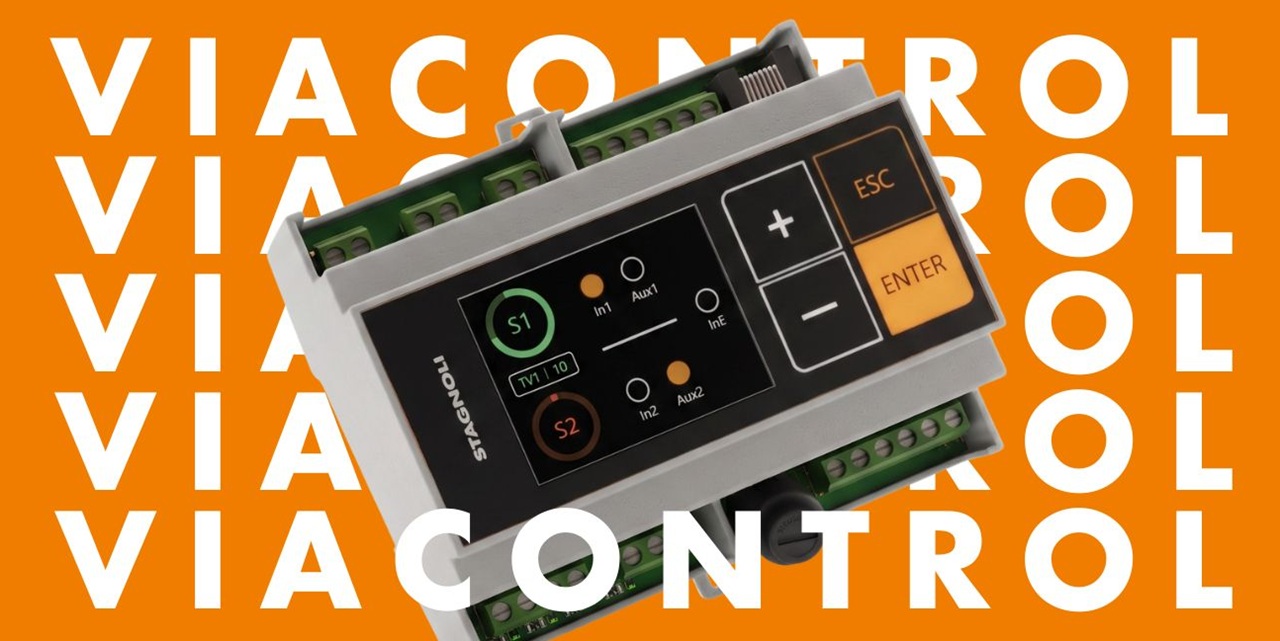
The new Stagnoli Accessories control unit drives two traffic lights from a single device and turns the right-of-way rules for ramps, driveways and private roads into green or red lights.
Where two traffic flows meet in a space that can only accommodate one, someone has to decide who goes first. VIACONTROL is the Stagnoli Accessories traffic-light control unit that does exactly that: it gathers information about what is happening at the passage, applies the logic selected during configuration and controls two traffic lights, with two or three lamps, accordingly. Designed and manufactured in Italy, it is built to bring order to a passage that today works only thanks to the common sense of the people using it.
It all starts with the display
The first thing you notice when opening the panel where VIACONTROL is installed is the integrated colour display. The system is configured through a guided menu, with fully spelled-out entries and values that can be read at a glance: no DIP switches to decode, no trimmers to adjust by trial and error. You choose the mode, set the timings and immediately check that the system does what you expect.
The advantage shows during commissioning, with less time and fewer errors, but above all afterwards: adjusting a green time or changing the logic remains within reach even of someone who did not install the system.
How the control unit thinks
The principle is simple: a well-designed traffic-light system is not just a more elaborate flashing light, it is a state logic. At any given moment the system is in a precise condition (right of way for one direction, clearance phase, closing, rest) and moves on to the next one when a condition is met. That condition may be an elapsed time, a signal coming from a detection device, or the status of the connected automation.
VIACONTROL offers three operating modes, corresponding to three different ways of triggering that transition.
Priority. One direction of travel is considered the main one and stays green by default. Green passes to the other direction only when a transit request arrives. This is the right logic where one flow clearly prevails over the other, for example when an incoming vehicle must not be left waiting on the public road.
Time. The two directions alternate according to cycles defined by the installer, with green and clearance times calibrated to the length of the stretch to be travelled. No detection devices are needed: the control unit works on its own, in a predictable and continuous manner. It is the best choice for alternating one-way stretches with constant traffic.
Status. The traffic light follows an external condition, typically that of the gate or barrier it is connected to. Green appears only when the passage is actually open and usable, and returns to red when it closes. This is the logic that keeps traffic light and automation together and avoids the most dangerous situation of all: a green light in front of a passage that is not yet clear.
Clearance time, the part that makes the difference
In an alternating one-way system the critical interval is not the green, it is the simultaneous red on both sides. It is the time the last vehicle that entered needs to exit at the other end before the opposing flow receives the go-ahead. On a twenty-five-metre residential ramp it is a few seconds; on a two-hundred-metre private road it is much more, and getting it wrong means two vehicles meeting halfway.
This is where a traffic-light system proves its real value, because safety does not depend on the number of available functions but on a parameter that is properly calibrated on site. VIACONTROL lets you adjust it to the actual geometry of the passage: length of the stretch, gradient, visibility and type of vehicles using it.
Then there is the point of view of those who pass through that gateway every day. A clearance time that is too long creates waits that seem unjustified, and a user who does not understand why they are stopped at a red light sooner or later decides to go through anyway. A time that is too short creates the very risk the system was meant to eliminate. Finding the right balance means building a signal that people trust, and a traffic light that is respected is the only traffic light that truly protects.
A single unit, fewer components in the panel
VIACONTROL mounts on a DIN rail and takes up six modules, so it fits in the panel next to the existing protection devices. It accepts a universal power supply from 24 to 230 V, which means a single part number to keep in stock for installations that are electrically very different from one another. The integrated auxiliary outputs make it possible to control motors, barriers or additional signage without adding external boards or relays, reducing wiring, points of failure and commissioning time.
Where it works best
Residential garages. The access ramp to the parking boxes is the textbook case: two cars meeting halfway up the slope and one of them forced to reverse. Two traffic lights and a priority or status logic solve the problem in a way anyone can understand, including guests entering for the first time.
Industrial and logistics sites. Here the flows change over the course of the day: employees arriving in the morning, heavy vehicles during the shift, exits concentrated in the evening. Time mode ensures regular alternation during heavy traffic, while status mode ties the signal to the actual opening of the gate or barrier during quieter phases.
Private roads, residential complexes and hospitality facilities. Narrow stretches, blind bends, bridges or single-lane passages. The traffic light communicates a clear rule to occasional users who do not know the place and have no way of knowing who is arriving from the other side.
Manoeuvring areas and car parks. Wherever a vehicle must stop before entering a space shared with pedestrians or other vehicles, the traffic-light head gives an immediate indication, visible even from a distance and in poor lighting conditions.
The complete system
VIACONTROL integrates with the traffic-light heads and automation accessories from Stagnoli Accessories: control unit and traffic lights designed to work together, with a single point of contact for supply and support. The support portal provides the manual, wiring diagrams and video tutorials dedicated to configuration.
Frequently asked questions
How many traffic lights can I connect to a single control unit?
Two traffic lights, with two or three lamps. This is the typical configuration of an alternating one-way passage, with one signal head for each direction of travel.
Can I use VIACONTROL with a gate or barrier that is already installed?
Yes. The control unit is independent of the automation and is also compatible with systems from other brands. In status mode it is sufficient to bring a contact to the control unit that signals the position of the passage.
Are photocells or magnetic loops required?
It depends on the logic chosen. Time mode works without any detection device, because it relies exclusively on the set cycles. The modes that react to the presence of a vehicle, on the other hand, require a device that generates the request signal.
What power supply does it require?
The power supply is universal, from 24 to 230 V. The same product therefore adapts both to extra-low-voltage systems and to panels powered directly from the mains, without having to choose a different version when ordering.
How much space does it take up in the panel?
It mounts on a DIN rail and takes up six modules, like a small group of protection devices. It does not require dedicated enclosures if the existing panel has space available.
How is it configured?
Through the integrated colour display, with a guided menu that walks you through choosing the mode and setting the timings. There are no DIP switches to decode and no trimmers to adjust by trial and error.
How are the times calculated?
The most delicate parameter is the clearance time, i.e. the interval during which both traffic lights stay red to allow the last vehicle to complete the route. It must be matched to the length of the stretch and the realistic transit speed, so it increases on long or uphill stretches.
Can I install it on a public road?
VIACONTROL is designed for private access: residential ramps, driveways, internal roads, manoeuvring areas. Installations on public land are subject to the authorisations and requirements of the body that owns the road and must be assessed case by case.
Who can install it?
Installation must be entrusted to a qualified technician, in compliance with the regulations in force on electrical systems and access automation.
About Stagnoli
_main.jpg "Stagnoli") Stagnoli Accessories is a solid Italian manufacturing company based in the Brescia area, founded in 1981. The company specializes in the design and production of accessories for gate automation (Home & Building Automation) and industrial luminous signaling. Although it has a strong international vocation—exporting to over 50 countries worldwide—it proudly maintains its entire production chain in Italy.
Stagnoli Accessories is a solid Italian manufacturing company based in the Brescia area, founded in 1981. The company specializes in the design and production of accessories for gate automation (Home & Building Automation) and industrial luminous signaling. Although it has a strong international vocation—exporting to over 50 countries worldwide—it proudly maintains its entire production chain in Italy.
















Comments
There are no comments yet for this item
Join the discussion