

T2 Systems: Radar or Loops? A Practical Look at Vehicle Detection at the Gate
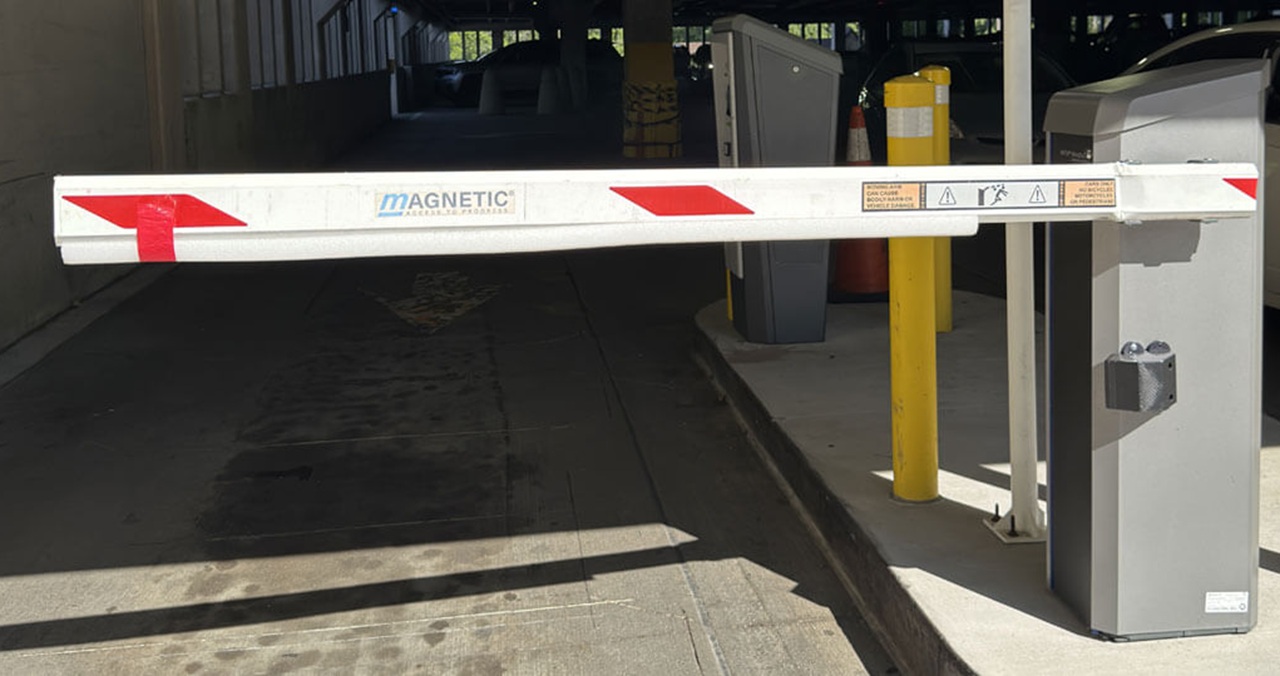
Something has to tell the gate a vehicle has arrived so it can open. Something has to tell it a vehicle is still underneath so it doesn’t close. Get that wrong and you get the two failures every parking operator knows by heart — a gate that won’t lift for a paying customer, and a gate that comes down on someone’s hood.
For decades the answer has been the induction loop: a coil of wire set into a saw-cut groove in the pavement, energized to sense the metal mass of a vehicle passing over it. It’s proven technology. It works. Millions of lanes run on it right now, including plenty of ours. But it isn’t the only answer anymore, and for a growing number of facilities it isn’t the best one.
Radar or loops for PARCS: the short answer
Barrier-mounted radar detects vehicles using a virtual zone in the air instead of a wire in the pavement. It installs without cutting concrete, its detection zones can be reconfigured from a phone, and it distinguishes vehicles from pedestrians and bicycles — something a loop cannot do, because a loop only senses metal mass. Radar is usually the better choice when pavement is aging or scheduled for resurfacing, when the deck is post-tensioned concrete that shouldn’t be cut, or when lane geometry changes.
In-ground loops remain the right call more often than vendors admit. A properly installed loop in a sheltered parking structure can last as long as the pavement around it, and parking garages are one of the friendliest environments loops ever get. If your loops work and your pavement is sound, replacing them solves a problem you don’t have.
And if you already cut for loops years ago, that decision doesn’t bind you. Switching a lane to radar doesn’t require excavating anything.
How radar and loops compare in the lane
| In-ground induction loops | Barrier-mounted radar | |
| How it detects | Magnetic field change caused by a vehicle’s metal mass | Millimeter-wave radar watching a defined zone |
| Installation | Saw-cut groove in pavement, sealed, wired to a detector | Mounts to the barrier housing; no pavement work |
| Changing the detection zone | Requires a new cut | Reconfigured in an app in minutes |
| Stationary vehicles | Yes | Yes |
| Pedestrians, bikes, motorcycles | Yes | Yes |
| Weather | Unaffected | Unaffected; unlike optical sensors, no clear sight path needed |
| Typical failure points | Pavement cracking, freeze-thaw, slab settling, water intrusion, resurfacing | Mounting position and sight line must suit the lane |
| Cost driver | The cutting, patching, and re-cutting | The device itself |
| Stationary vehicles | Sound pavement with working loops; new pours where the slab is already open; unusual lane geometry with no good mounting point | Aging or soon-to-be-resurfaced pavement; post-tensioned decks; lanes that change; lanes shared with foot traffic |
Which one fits your lane?
Five questions sort most facilities quickly.
When is the pavement getting resurfaced? If repaving is on the capital plan in the next few years, new loops installed today get destroyed then. That’s paying twice for the same detection.
Is this an elevated deck? Find out whether the slab is post-tensioned before anyone quotes a loop install. Post-tensioned concrete carries steel tendons under enormous tension, and cutting into one is a serious safety event — it requires ground-penetrating radar scanning to locate the tendons first, and often engineering review. In precast, prestressed decks, saw-cutting can compromise the slab outright.
How often do lanes change? Event venues, campuses with seasonal patterns, and operations that reverse lanes for peak flow get the most out of zones that move without concrete work.
How much foot traffic shares the lane? At campus cores, hospital entrances, and mixed-use garages, people regularly walk through the gate area. A loop cannot see them. If that’s your environment, vehicle-versus-pedestrian differentiation is worth real money in avoided incidents.
What does a loop failure actually cost you? Not just the repair. Count the service call, the lane out of service, the staff time spent standing at a gate lifting it by hand, and the driver who now believes your garage is unreliable.
Already cut for loops? You’re not locked in
There’s an assumption worth clearing up, because it stops a lot of operations before they start: that having already cut your pavement for loops somehow commits you to loops forever. It doesn’t.
Switching a lane from loops to radar is not a demolition project. The sensor mounts to the barrier housing, the zones get configured, and the old loop is disconnected and left where it is. Nothing has to come out of the ground.
That’s actually easier than the alternative. When you replace a failed loop with a new loop, the old one becomes a problem — an abandoned coil under a new one can act as a shorted turn, producing false detections and detector lock-up that are notoriously hard to trace, because the failed loop isn’t connected to anything and shouldn’t be doing anything. Radar doesn’t work by inductance, so an abandoned loop is invisible to it. The wire in the ground just stops mattering.
You also don’t have to convert everything at once. Lanes are independent.
You also don’t have to convert everything at once. Lanes are independent, so an operation can run radar at the entrance where the loop keeps failing and leave the rest alone until there’s a reason to change. That’s how most of the transitions we’ve supported have gone: one high-traffic lane first, then expansion once the operation sees it run through a full season. Running both technologies across one campus is normal, not a compromise.
How each technology actually works
For readers who want the mechanism, not just the recommendation.
The induction loop
A loop is insulated wire laid into a groove cut roughly an inch and a half to two inches deep in the pavement, sealed over, and run back through a lead-in cable to a detector at the gate. The detector pushes alternating current through the coil, creating a magnetic field. When a vehicle’s metal mass enters that field, the loop’s inductance changes, the detector notices, and it signals the gate.
That’s the whole mechanism, and its simplicity is why it has lasted. Nothing to aim, nothing to keep clean, nothing that cares whether it’s foggy.
Most gated lanes use more than one. An arming loop sits ahead of the gate to trigger the lift. A safety loop sits directly under the arm so the gate won’t come down on a vehicle still underneath. Some operations add a third for directional logic or tailgate detection.
Loops don’t usually fail because the technology is bad. They fail because they live in the pavement, and pavement moves. Cracking, freeze-thaw cycles, slab settling, and water working into the sealant all degrade the wire over time. The hard part is the diagnosis: a loop that has been intermittent for six months shows up as an unhappy driver at 4:45 p.m., with the cause invisible under the concrete.
Barrier-mounted radar
A radar scanner replaces the wire in the ground with a virtual detection zone in the air. The unit mounts on the barrier housing and uses millimeter-wave radar to watch a defined area of pavement in front of and beneath the gate. Instead of one physical loop per function, zones are configured in software: an opening zone that triggers the lift, and a safety zone that holds the arm up while something is still underneath. Two virtual loops, one device, no groove.
Three capabilities matter more than the installation story:
It detects stationary objects, not just moving ones. Some non-loop sensors only see motion, which is a problem for a car sitting still under a gate arm. Millimeter-wave radar sees both static and dynamic objects in the zone.
It distinguishes a vehicle from a pedestrian. The scanner separates a vehicle from a single person, with enhanced detection for people on foot, bicycles, and motorcycles. That’s the capability a loop structurally cannot offer, and it’s the one most operators don’t realize is now available.
Weather is not a factor. Optical and infrared sensors struggle in fog, heavy rain, blowing snow, and low sun angle. Radar doesn’t rely on a clear optical path, and rated hardware operates through the temperature swings a North American garage entrance actually sees.
There’s also a directional element. Cross-traffic suppression and direction-of-movement detection let the sensor ignore a car crossing the field on its way somewhere else, rather than lifting the gate for a vehicle that was never coming.
Where loops still win
Worth being specific, because this is where technology comparisons usually get dishonest.
Your existing loops are healthy. The most common case and the most important one. If your loops work and your pavement is sound, upgrade at the natural moment — when a loop fails, when the lot is resurfaced, or when you’re rebuilding the lane anyway.
The slab is already open. In new construction or a full deck replacement, setting loops before the pour costs very little. The expensive part of a loop is the cutting, and if there’s no cutting, the math changes.
There’s nowhere good to mount a sensor. Very wide lanes, unusual approach geometry, or a lane with no suitable mounting height and angle. A loop doesn’t care about sight lines.
Multiple loops are doing logic work. Some operations use several loops in sequence for directional control, tailgate detection, or count verification, tuned over years to that specific lane. There’s no prize for replacing an arrangement that works.
You want metal-only detection. Because a loop responds only to metal mass, it ignores people, debris, and animals by design. In some lanes that’s exactly the behavior you want.
The honest summary: radar replaces loops well in most gated parking configurations, not all of them. Anyone who tells you a single detection technology wins every lane is selling, not advising.
The T2 view
T2 PARCS supports both. We install loops where loops are right, and we support the MWD SBP radar scanner for the growing number of facilities where they aren’t.
In practice, the operations moving to radar are doing it at natural decision points — the lane where the loop just failed, the lane about to be repaved, the new lane going into a deck where nobody wants to cut the slab. The sensor mounts to the barrier, the zones get configured from a phone, and the lane comes back into service the same day.
Not a rip-and-replace project. A new default: the next time a lane is opened up, ask whether it needs to be cut at all.
Want to see what radar detection would look like in your lanes? Download the T2 PARCS Vehicle Access Control & Sensor Technology one-pager or talk to our team about your facility.
Frequently asked questions
Can radar replace in-ground loops at a parking gate? Yes. A barrier-mounted radar scanner creates virtual detection zones that perform the same opening and safety functions as arming and closing loops, without cutting the pavement. Zones are configured in software and can be adjusted later without concrete work.
Do you have to remove old loops to switch to radar? No. The old loop is disconnected and left in place. Radar doesn’t detect by inductance, so an abandoned loop has no effect on it — unlike replacing a loop with another loop, where an abandoned coil can cause false detections.
Does radar detect pedestrians and bicycles? Yes. Millimeter-wave radar detects people on foot, bicycles, and motorcycles, and distinguishes them from vehicles. An induction loop cannot, because it senses metal mass rather than presence.
How long do in-ground loops last? A properly installed loop can last as long as the pavement around it, often a decade or more, and parking structures are a comparatively protected environment. Lifespan drops with pavement cracking, freeze-thaw exposure, slab movement, and water intrusion, and any resurfacing project ends it.
Does weather affect radar vehicle detection? Radar doesn’t require a clear optical path, so fog, rain, and snow don’t degrade detection the way they can with infrared or optical sensors. Hardware rated for outdoor use operates across the temperature range a North American garage entrance sees.
Can you cut loops into a post-tensioned parking deck? Only with proper precautions. Post-tensioned slabs carry steel tendons under high tension, and cutting one is a serious safety hazard. Ground-penetrating radar scanning to locate the tendons is required before any cutting, and structural review is often necessary. In many elevated decks, surface-mounted detection avoids the question entirely.
About T2 Systems 
T2 is the largest provider of parking and mobility solutions in North America. With over 27 years in business, T2 now serves more than 2,000 customers and maintains the largest Customer Community with over 7,500 active members. T2 helps universities, municipalities, operators, healthcare campuses, and transportation hubs generate revenue and operate efficiently with a comprehensive, integrated suite of solutions featuring touchless and contactless capabilities. From curbside management to gateless, from mobile payments to transportation demand management, T2 strives to make every trip a smooth journey by streamlining the parking, mobility, and transportation experience with technology solutions that help organizations manage resources, achieve goals, and empower consumers with choices.
















Comments
There are no comments yet for this item
Join the discussion