

CSL Group: Fire Risks Posed by EVs to Buildings & Car Parks
A Comprehensive Analysis
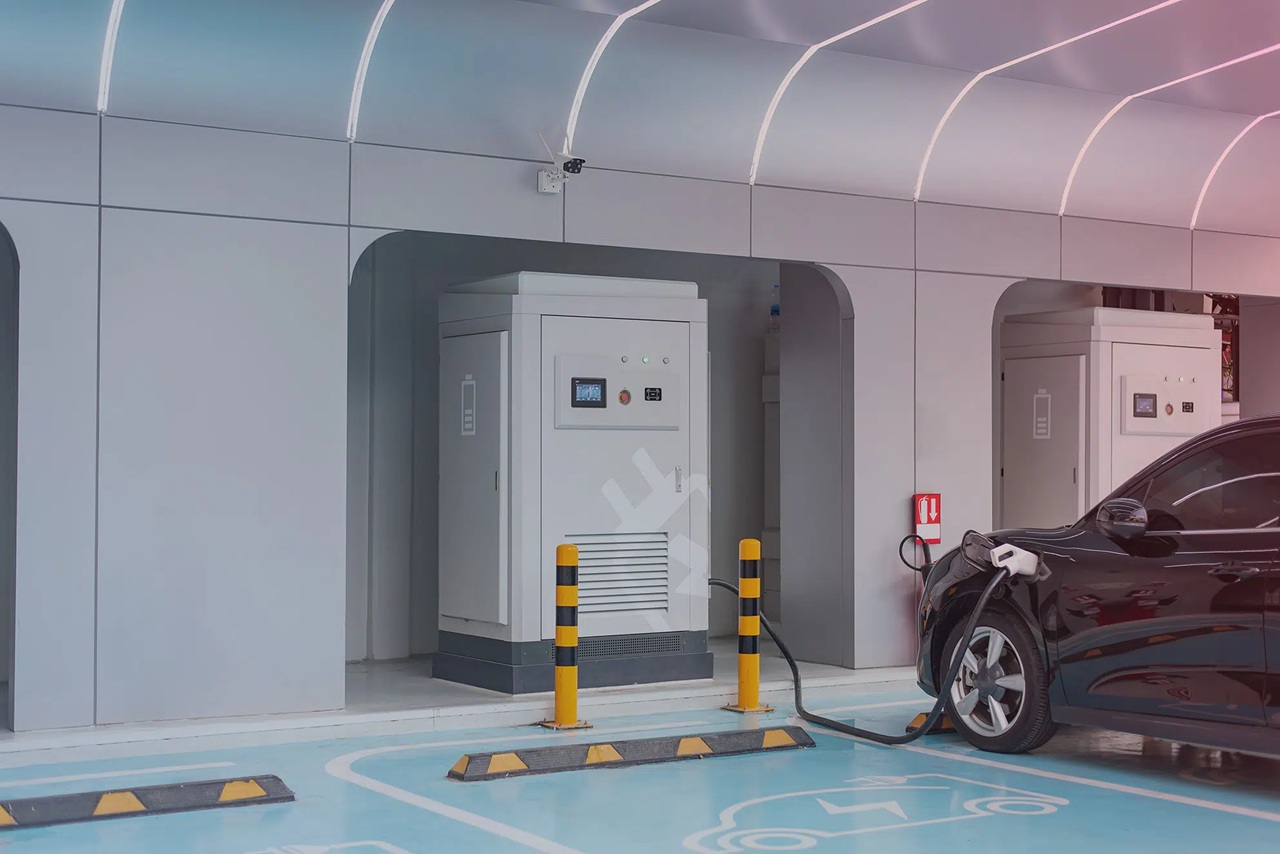
The increasing adoption of electric vehicles (EVs) marks a significant and exciting transition for the automotive industry, driven by NetZero regulations, a broader environmental consciousness, and technological advancements.
This shift, however, also necessitates a thorough examination of the potential fire risks EVs present to buildings and car parks. While EVs, statistically, exhibit a much lower propensity for fires compared to internal combustion engine (ICE) vehicles, the unique characteristics of EV battery fires demand specific safety protocols and mitigation strategies.
As EVs and EV charging systems become integrated into urban infrastructure, they introduce additional structural, electrical, environmental and cybersecurity risks that require coordinated management.
This article therefore provides a comprehensive analysis of the types of risks related to fire (with a focus on car parks), exploring the challenges and proposing some recommendations for enhancing safety in those buildings and car parks that are accommodating them.
EV Charging Fire Detection Thermal Runaway. How to Mitigate Risks.
Overview of Fire Risks: EVs vs. ICE Vehicles
Statistical Probability of Fire Incidents
Research indicates that EVs are generally less prone to catching fire than their ICE counterparts. This lower fire incident rate is often attributed to the simpler mechanical design and fewer flammable fluids present in EVs. For example, a study in Sweden in 2022 revealed that EVs had a fire incidence of 0.004%, significantly lower than the 0.8% observed in gasoline and diesel vehicles. Other studies by the US National Transport Safety Board (NTSB) suggest that 1 in every thousand ICE vehicles will catch fire, compared to 1 in every 83,333 EVs. Further evidence is that despite EVs growing at significant rates, vehicle fires as a share of the total has remained mainly around 20% for most countries.
Despite the promising statistics for EVs, the unique nature of EV battery fires does require careful consideration as the impact, propagation and explosion risks can be far greater than those involving ICE vehicles. We also need to consider hybrid vehicles as several studies also show that hybrid vehicles present a greater risk than both ICE and BEVs. These having particular implications for enclosed areas where EVs are either parked or stored. For example:
Location of Fires: ICE vehicle fires often occur during operation, while EV fires tend to happen when parked and charging. This can lead to property damage, especially in car parks.
Cause of Fires: EV battery fires are primarily caused by faults in battery design, overheating, or collisions, which can trigger thermal runaway. For example, approximately 15% of EV battery fires have been found by studies to occur while connected to charging. Faulty components accounting for a large percentage of incidents.
Thermal Runaway: Thermal runaway is a significant concern for the fire prevention industry, as a damaged battery cell can overheat, causing a chain reaction that leads to more cell failures and potential explosions. Early warning signs include detectable heat, dashboard fault codes, popping noises, and dark vapours.
While the incidences of EV fires might be low, it is also essential to consider risks to battery overheating from the charging infrastructure itself, including compliance with electrical safety standards and full integration into building safety systems.
Location and Cause of Fires
Unlike ICE vehicle fires, which predominantly occur during operation due to engine overheating or fuel leaks, EV fires appear to have a tendency to happen when the vehicles are parked and charging. This distinction is crucial, particularly for buildings and car parks, as parked vehicles (including ICE, EVs and Hybrids) within enclosed spaces can lead to significant property damage and pose risks to occupants if a fire takes hold.
While the causes of fires in ICE and to an extent Hybrids are more understood, there is less research or data on the causes of EV fires.
Research does, however, suggest that some of the primary causes of EV battery fires include faults in battery design, manufacturing defects, overheating during charging, and physical damage resulting from collisions. Incidents often involve the process of thermal runaway; a dangerous chain reaction within the battery.
Fires and safety risks can also be heightened by charging systems installed with non-compliant installations. Increasing the risks of electrical faults and electrocution for responders once a fire has initiated by failing to cut off the supply.
Some Notable Examples of Major ICE, Hybrid, BEV and Car Park Fires and their Impact:
There have been some notable recent fires in car parks that have focussed public attention. While many of these have been found to be initiated by ICE or Hybrid vehicles, the additional complexity created by the coexistence of ICE, Hybrid, and EVs creates a potential for greater uncertainties in terms of their interactions once a fire is initiated and has then taken hold.
- Luton Airport Fire (2023): A fire started by a Diesel ICE in a parking structure destroyed over 1,300 cars and caused significant disruptions.
- First report was from a member of the public.
- 100 Firefighters and 15 Appliances
- 3 Firefighters and 1 member of public hospitalised due to smoke inhalation
- 27 arriving flights rerouted.
- 30,000 passengers impacted.
- £10m in insurance claims by motorists
- Car park badly damaged and demolished – Built for £20m in 2019.
- High-Rise Residential Complex, Korea (2021): A BEV fire spread rapidly, damaging 90 vehicles and affecting 800 more, leading to infrastructure outages and parking restrictions.
- Stavanger Airport, Norway (2020): A fire affected around 300 vehicles in a confined parking area.
Fires in enclosed car parks (of whichever vehicle types) also pose higher risks of toxic gas accumulation, complicating evacuation, and suppression efforts for site operators and emergency services.
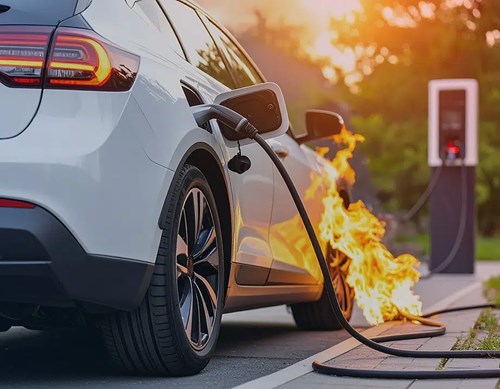
Some Characteristics of EV Fires:
In understanding the specific risks of EV fires, it is important to understand some of the processes involved in this type of vehicle technology.
- Thermal Runaway: EV fires are driven by thermal runaway, a chain reaction in lithium-ion batteries causing rapid temperature-rise and fire spread. This can occur immediately after a crash or even weeks later.
- Critical Detection Window: EV fires typically begin 20 to 25 minutes after thermal runaway begins, with temperatures exceeding 1000°C within 2 minutes of the fire starting. Early detection within the first 20 to 25 minutes is therefore crucial to prevent escalation.
- Fire Intensity: Once started, EV fires reach higher peak heat release rates (PHRR) faster than ICE fires, with EVs hitting 4000 kW at 15 minutes compared to 19 minutes for newer ICE vehicles.
- Explosion Risks: Flammable gases released during EV fires can accumulate and lead to deflagration (explosions) in confined spaces such as car parks. Smart gas venting systems can help mitigate this risk.
- Toxic Emissions: EV fires release hazardous gases and metals, posing significant health and environmental risks. These gases include hydrogen fluoride and hydrogen chloride, presenting severe health hazards in confined spaces.
- Extinguishing Challenges: EV fires are harder to extinguish due to the battery’s internal oxygen supply. Specialised methods like large water volumes or submersion are required.
- Re-Ignition Risk: Damaged EV batteries can reignite hours or days after being extinguished, necessitating continuous monitoring.
- Emergency Responder Hazards: EV fires pose unique risks for responders, including toxic emissions, electrocution, silent vehicle movement, and projectiles from exploding battery cells.
The Phenomenon of Thermal Runaway
Thermal runaway is a critical concern in EV battery fires. It occurs when a battery cell experiences a short circuit or overheating, leading to an uncontrolled increase in temperature. This can cause cell failures, the release of flammable gases, and potentially explosions. Early warning signs of thermal runaway include:
- Dashboard fault codes
- Heat emanating from the vehicle.
- Unusual popping noises emanating from the battery pack.
- The emission of dark vapours.
The escalation typically follows predictable stages: initial overload or damage compromises a cell, generating heat, releasing toxic gases, triggering further failures, and making suppression extremely difficult. Long-term monitoring is often required even after apparent extinguishment to make sure that the fire does not reappear.
It should also be noted that ISO 15118 (vehicle to charge-point communications) does also cater for vehicle battery temperature monitoring while charging and it is therefore important that this is implemented and resiliently connected to an EV charging management system with corresponding alerts and emergency actions. This should also ideally include the building and safety management system, to enable immediate alerts to be sent.
In terms of identifying fires, time is therefore of the essence, and it is likely that multiple approaches and network redundancy are required to ensure early detection. For example, measures that are central to the vehicle systems, the charging system and network, and external monitoring systems.
Understanding and mitigating thermal runaway is therefore an essential part of developing effective fire safety strategies.
To help understand the processes that are often involved in EV fires, a flowchart illustrating the process of thermal runaway in lithium-ion batteries is provided below:
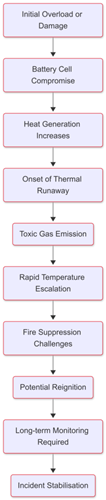
This diagram emphasises the sequential escalation from initial battery compromise to the challenges in fire suppression and the need for persistent monitoring.
Unique Challenges Posed by EV Battery Fires Once they have Taken Hold
Difficulties in Extinguishing Fires
EV battery fires present significant challenges to emergency responders due to the energy density and chemical composition of lithium-ion batteries. Unlike ICE vehicle fires that can be extinguished relatively quickly, EV battery fires can burn for extended periods, often lasting 4-5 hours on average. Traditional suppression techniques are less effective, as the battery’s internal oxygen supply sustains combustion, even when external flames are suppressed. Effective suppression methods often involve:
- Applying large volumes of water (potentially up to 10,000 litres or more) to cool the battery pack.
- Submerging the vehicle in a water-filled container to ensure thorough cooling.
- Elevating the vehicle to allow direct access to the battery pack for cooling.
- For example, in the US, firefighters used 20,000 litres of water for over 2 hours and could only cool the battery after the vehicle was lifted, and water hosed directly towards the battery enclosure. The vehicle however reignited on the tow truck and again in the depot.
Toxic Emissions and Environmental Concerns
EV battery fires also release a cocktail of toxic and flammable vapours, including hydrogen fluoride and hydrochloric acid, posing both respiratory and explosion hazards. These emissions can contaminate the surrounding air and water, necessitating careful environmental management during and after fire incidents. Emergency responders must wear appropriate personal protective equipment (PPE) to mitigate the risks of chemical exposure.
Risk of Re-Ignition
A unique and alarming aspect of EV battery fires is the potential for re-ignition hours or even days after the initial fire has been extinguished. This phenomenon is attributed to previously damaged battery cells that can ignite after an initial fire has been suppressed. Therefore, continuous monitoring of damaged EVs is crucial to prevent secondary fire incidents.
New Hazards for Emergency Responders
EV battery fires introduce new risks and complexities for emergency responders, including:
- Silent, uncontrolled vehicle movement due to damaged electrical systems.
- Jet-like directional flames that can spread rapidly.
- The risk of projectiles being ejected from exploding battery cells.
- Chemical exposure from toxic emissions.
- Electrocution hazards from high-voltage systems.
Designers must also account for structural loading, especially where dense battery arrays or storage units may stress older car park infrastructure that may be subject to damage.
The level of compliance of charging equipment also significantly affects safety. For example, compliant AC systems use Residual Current Devices (RCDs), circuit breakers, and isolator switches within two meters of the unit to ensure automatic power cut-off during faults, enabling safe suppression by qualified responders. Non-compliant installations lack these features, posing severe electrocution risks for users and emergency responders under failure conditions.
Covered Car Parks: UK Government Interim Guidance
Causes of Charging-Related Fire Incidents
Research indicates that a notable proportion of EV fires occur while the vehicles are connected to charging units or shortly after disconnection. These incidents can result in fires originating from the traction battery or electrical sources within the charging infrastructure. For example, some studies have revealed that over a third of reported incidents involve fires at charging units or soon after disconnecting. (Note that statistical research is subject to key variations and that while some studies highly state this as a correlating factor, others present it as less prevalent).
In properly functioning EVs connected to electrically compliant charging units, the battery management system (BMS) prevents overcharging.
Instead, charging-related fires often appear to stem from pre-existing vehicle damage, manufacturing defects, or external factors that are then exacerbated by resultant charging. Analysis of EV fire incidents reveals that the primary causes of charging-related fires appear to include:
- Vehicle damage from collisions.
- Submersion in floodwater, leading to short circuits and corrosion.
- Un-responded manufacturer recalls due to defects in battery design or charging systems.
- Exposure to external fires that compromise battery integrity.
Operating a fully connected and secure EV charging network and vehicle monitoring system is therefore a vital part of fire safety, preferably with additional measures for detecting and communicating the signs that thermal runaway is occurring on site and to centralised systems.
Operational best practices such as maintaining a lower State of Charge (e.g., below 50% for stored vehicles) can also help reduce the risk of initiating thermal runaway.
(Continue reading the analysis)
About CSL Group
CSL was founded by Simon Banks in 1996, as a UK alarm signalling provider. Today, we have over 2 million managed connections supporting mission-critical IoT applications across Europe, and we are continuing to grow and innovate.
We connect, manage and secure the Internet of Things. The world of Critical Connectivity is ever changing. We're constantly developing, evolving and transforming our platforms and services to bring our customers more powerful connected solutions.
















Comments
There are no comments yet for this item
Join the discussion