

Survision: Front Reading vs. Rear Reading in License Plate Recognition and Vehicle Identification
The Important Implications of These Two Very Different Aproximations to LPR
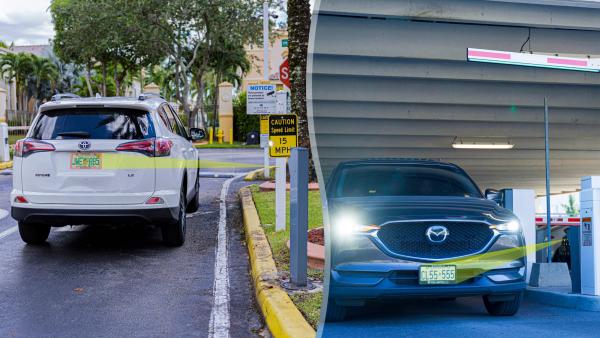
One of the most important decisions when deploying an LPR system is whether to read plates from the front or rear of vehicles. This choice can significantly impact installation complexity, camera performance, recognition accuracy, and system reliability. It also depends heavily on regional plate laws and vehicle design. Understanding the pros and cons of both approaches helps operators make informed decisions for their specific use cases.
Front vs. Rear Plate Reading?
Front Reading refers to capturing the vehicle’s license plate as it approaches a camera, typically at entrances of parking lots or checkpoints. This method is highly effective in jurisdictions where front license plates are mandatory, and it's ideal for proactive detection and access control.
Rear Reading is the process of capturing license plates from the back of a vehicle, often after it has entered a facility. This method is common in regions where front plates are not required, such as many states in the U.S., or when vehicles like motorcycles only display rear plates.
The placement of the LPR camera—whether it faces oncoming or departing vehicles—affects not only the detection angle and lighting conditions but also how early or late in the process the plate is read, which influences security and system responsiveness.
Regional Variance
LPR usage and plate-reading strategies vary widely around the world. In Europe, most countries require both front and rear license plates, making dual-sided LPR systems standard. France and Germany, for example, issue highly legible standardized plates that work seamlessly with front and rear reading setups. The UK uses white front plates and yellow rear plates, which enhance visibility in various lighting conditions.
In the United States, there’s less uniformity. While 29 states require both front and rear plates, 21 states mandate only rear plates. This creates challenges for nationwide LPR deployments and often leads to rear-reading-only installations. Australia follows a similar model, where license plate requirements and formats differ between states and territories.
The lack of standardization globally means that LPR systems must be adaptable. Camera positioning, optical character recognition (OCR) algorithms, and lighting configurations all need to be fine-tuned to local requirements and vehicle behaviors.
Front Vs. Rear Reading Challenges
Environmental conditions and vehicle configurations can affect LPR performance; moreover, the plate position (rear or back) modifies how these conditions impact LPR accuracy.
| Challenges | Front Reading | Rear Reading |
| Dirt | Front plates get dirty faster due to wind and road debris, but are also cleaned more regularly. | Rear plates are protected from frontal debris but stay dirty longer due to lack of airflow. |
| Damage | Front plates are more exposed to impact from road debris and minor collisions. | Rear plates are often mounted within the vehicle body, reducing exposure and potential damage. |
| Visibility | Front plates are usually unobstructed and clearly visible as vehicles approach. | Rear plates can be obscured by tow hitches, trailers, bicycles, or mud. |
| Reflection | Front plates are typically installed horizontally, minimizing sun glare. | Rear plates may be angled, causing glare or headlight reflections at certain times of day. |
Back-In Vs Front-In parking has been a debate for long since both methods offer pros and cons; the case of univiersities and their parking police is a good example: Often driven by safety and efficiency, many universities require vehicles to park front-in, this solves many problems and brings uniformity and compliance, taking into account that in some places, front plates are optional; however, some think that back-in parking can reduce accidents in pedestrian-heavy environments like campuses, as it allows the vehicle to exit forward and the driver to have a better field of view.
Why Some Regions Use Both Plates — And Others Don’t
The presence or absence of front plates is largely a function of legislative history and administrative policy. In the U.S., for example, states like California and New York mandate front and rear plates for easier enforcement and better visibility, while states like Florida and Arizona do not, citing cost savings and aesthetic concerns.
More advanced in control technologies, European countries generally require both plates for consistent identification from all angles. The rationale includes improved public safety, more reliable toll collection, and better integration with surveillance infrastructure.
Some law enforcement agencies argue that front plates are essential for identifying oncoming vehicles, especially in hit-and-run scenarios or when vehicles are caught on traffic cameras from the front. On the other hand, regions that favor rear-only plates often cite the minimal enforcement benefit as the reason for the additional cost.
Understanding these legal and cultural differences is crucial for tailoring LPR deployments effectively. Operators must consider not only what’s allowed, but also what offers the best operational outcome based on local conditions and vehicle norms.
Dual-Reading: A Leap Forward in LPR Accuracy
While rear-reading systems are common in regions like the U.S., adding front-reading capability can significantly boost system accuracy. Using Survision’s dual-camera LPR solution, Ontario Airport in California reported a 4% increase in accuracy after implementing a front-read dual reading.
To quantify: in a 100 vehicles per day lane, a 4% increase means 4 additional vehicles accurately recognized daily. Over a week, that’s an increase of 120 monthly vehicles properly captured, a significant reduction on lost revenue, misreads, or access control errors.
This improvement is even more significant in high-traffic environments, such as airports, toll roads, and secure campuses, where thoroughness and reliability are crucial. Survision’s technology enables cameras to communicate with each other, comparing and validating reads from both ends of the vehicle to ensure maximum recognition precision.
Adapting to the Future
With regional regulations continually shifting and technology advancing rapidly, adaptability is crucial. LPR systems that embrace flexible installation strategies and smart data fusion will lead the next wave of intelligent mobility.
The future of license plate recognition isn’t just about reading a single plate—it’s about understanding the entire vehicle. Whether a system uses front, rear, or dual-reading cameras, the end goal is accuracy, efficiency, and reliability. As the industry evolves, we’re seeing a growing interest in multi-angle recognition, AI-assisted vehicle profiling, and broader identification features, such as vehicle make, model, and color.
About SURVISION 
SURVISION Cameras and Cloud Applications are specifically designed for vehicle control and identification solutions such as Ticketless Parking, Traditional Parking, Parking Enforcement, Access Control, Security, and more. Survision is a global leader in license plate recognition and vehicle identification with over 60,000 cameras installed worldwide.
















Comments
There are no comments yet for this item
Join the discussion