

Urbiotica: Parking Sensor Lifespan – What Happens After Ten Years?
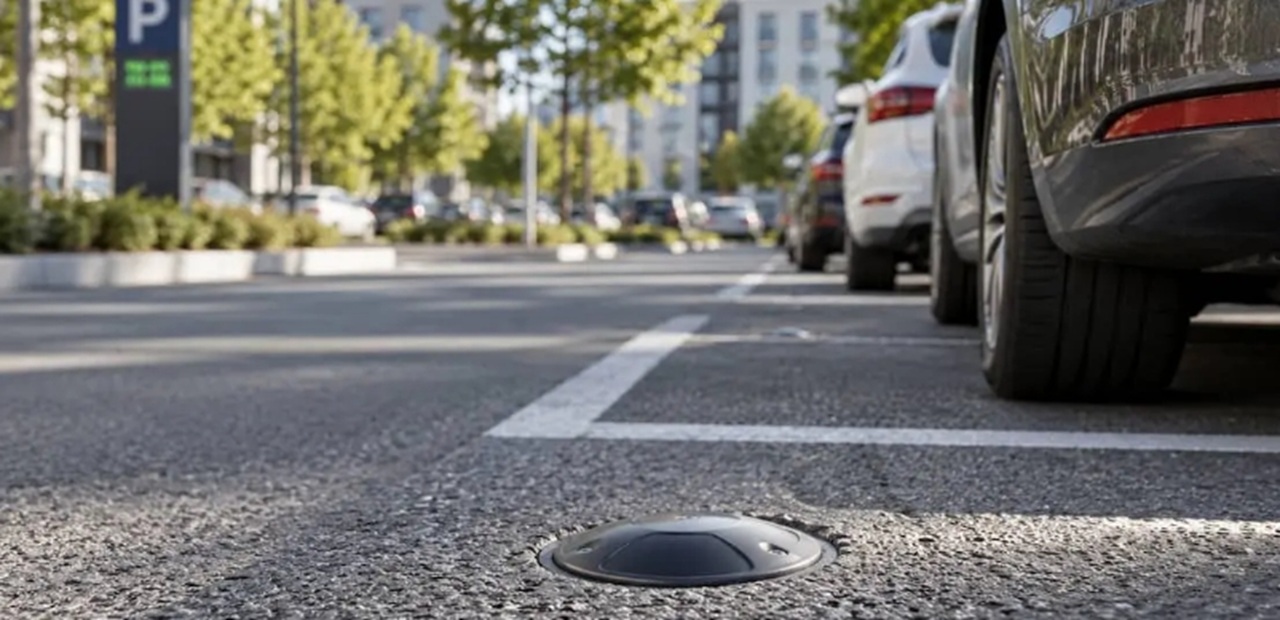
Battery life is one of the factors that can have the greatest impact on the cost and maintenance requirements of a smart parking project. When hundreds or thousands of sensors are installed across a city, extending their operating life means fewer replacements, fewer maintenance visits and, in many cases, fewer interventions on the road surface.
But there is something particular about sensor lifespan: for many years, manufacturers could only talk about it in terms of estimates.
Battery capacity, expected energy consumption, communication frequency and operating conditions can all be used to calculate how long a device should last. This is the logical approach when designing a new technology.
Today, however, some smart parking projects have been operating for more than a decade. And that gives us something that was not available a few years ago: real-world data.
Battery capacity is only part of the equation
A sensor’s operating life depends on more than its battery capacity. The system architecture and the way the device uses energy also have a direct impact.
Communication frequency is one important factor. Sending data more frequently requires more energy, so the challenge is to find the right balance between keeping information up to date and avoiding unnecessary communications.
A cloud-based architecture also makes it possible to optimize this balance throughout the lifetime of the project. By keeping the detection intelligence in the cloud, algorithms can be optimized and transmission frequency adjusted without physically accessing sensors already installed in the field.
Other factors, including electronic efficiency, hardware and firmware design, and energy management, also contribute to overall sensor lifespan.
So when evaluating the autonomy of a parking detection solution, it is worth looking beyond battery specifications and considering how the entire system has been designed.
What does the data show after more than a decade?
Urbiotica has analyzed the performance of sensors from one of its longest-running projects, deployed at a large shopping center in Vienna with 2,437 monitored parking spaces.
Data updated on April 13, 2026 provides insight into a sample of 1,205 sensors — close to 50% of the entire deployment.
Within this sample, 109 sensors remain operational after more than ten years, with an average recorded lifespan of 10.27 years. Another 172 sensors installed more than nine years ago are still operating, with an average of 9.9 years.
Across the full sample of 1,205 devices, the average lifespan recorded to date is 8.33 years. Importantly, this does not necessarily represent their final lifespan: a significant number of these sensors are still transmitting data, meaning their recorded operating life will continue to increase for as long as they remain active.
The analysis calculates lifespan as the period between the installation of each sensor and the last communication received from that device on the platform.
For the sensors included in these figures, batteries have not been replaced and no physical intervention on the devices has been required.
From estimated lifespan to real-world evidence
As smart parking technology matures, solutions can increasingly be evaluated from a different perspective: not only through technical specifications and engineering estimates, but also by looking at what actually happens after years of real-world operation.
This is particularly relevant when considering the total cost of a project. Reliability, operating life and maintenance requirements throughout the lifecycle of the system can be just as important as the initial investment.
After more than a decade of deployments, real-world data is beginning to provide something that was previously impossible: the ability to compare estimated sensor lifespan with actual long-term performance in the field.
About Urbiotica
Urbiotica is a technology company specialized in smart parking and mobility solutions for cities and complex urban environments. With a strong focus on IoT, artificial intelligence, and data analytics, Urbiotica helps public authorities and parking operators improve traffic flow, optimize parking operations, and enhance the overall user experience. Its solutions are deployed in cities and facilities worldwide, supporting data-driven decision-making for more efficient, sustainable, and accessible urban mobility.
Learn more about Urbiotica and its smart parking solutions at www.urbiotica.com
















Comments
There are no comments yet for this item
Join the discussion